
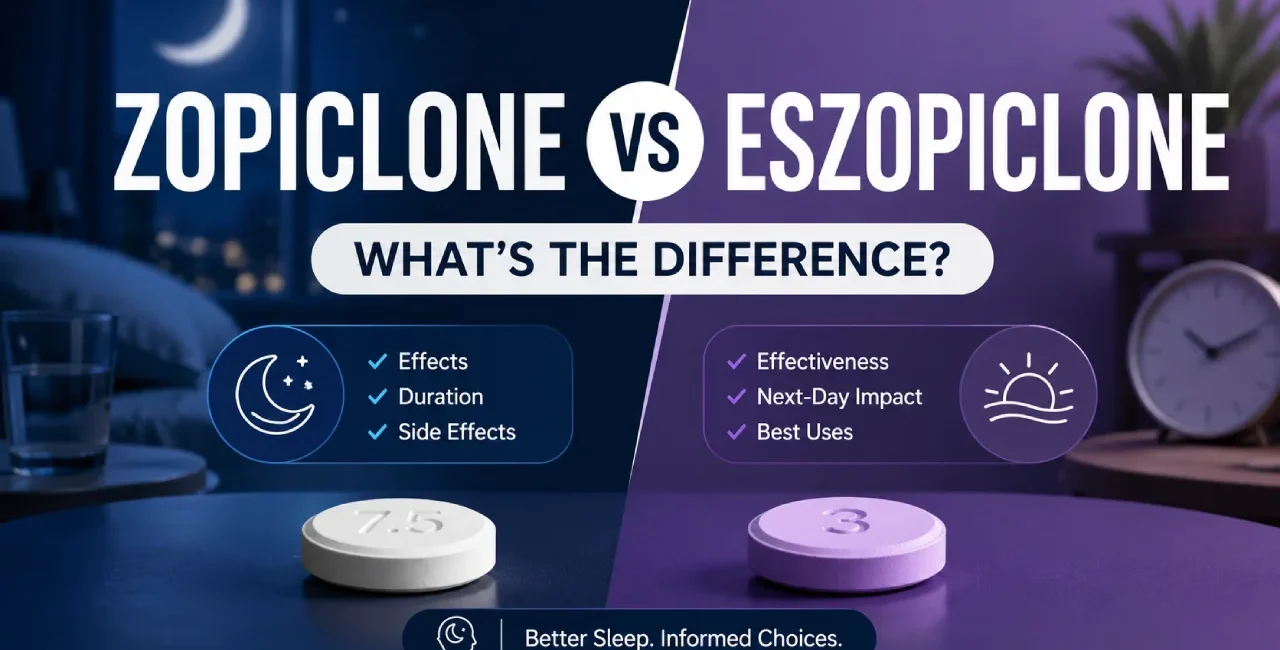
Zopiclone vs Eszopiclone: What’s the Difference?
If you’re searching for an effective sleep tablet in the UK, you’ve almost certainly come across both zopiclone and eszopiclone. They sound similar, they work similarly — so what’s actually the difference, and which one is right for you?
This guide gives you a complete, side-by-side comparison of both medications: how they work, their strengths and weaknesses, dosing differences, side effects, and which one might be the better fit depending on your situation.
Quick Overview: Zopiclone vs Eszopiclone
| Feature | Zopiclone | Eszopiclone |
|---|---|---|
| Drug Class | Non-benzodiazepine (Z-drug) | Non-benzodiazepine (Z-drug) |
| Relationship | Parent compound (racemic) | Active isomer of zopiclone |
| Available Doses | 3.75mg, 7.5mg, 10mg, 20mg, 25mg | 1mg, 2mg, 3mg, 6mg |
| Standard Adult Dose | 7.5mg | 2mg–3mg |
| Half-Life | ~5 hours | ~6 hours |
| Bitter Aftertaste | Very common | Less common |
| Next-Day Grogginess | Moderate | Lower |
| Long-Term Use Studies | Short-term data | Up to 6-month studies |
What Is Zopiclone?
Zopiclone is a non-benzodiazepine sedative-hypnotic (commonly called a Z-drug) used to treat insomnia. It has been prescribed in the UK and Europe since the late 1980s and is one of the most widely recognised sleep medications available.
Zopiclone works by enhancing the effects of GABA — a naturally occurring brain chemical that slows down nerve activity. The result is a calming, sleep-inducing effect that helps you fall asleep faster and stay asleep longer.
Key Facts About Zopiclone:
- Available in multiple strengths from 3.75mg up to 25mg
- Standard UK adult dose is 7.5mg
- Elderly patients are typically started at 3.75mg
- Works within 30–60 minutes of taking
- Lasts approximately 6–8 hours in the body
- Can cause a distinctive metallic or bitter taste — one of its most commonly reported side effects
Zopiclone is a racemic mixture — meaning it contains two mirror-image versions (isomers) of the same molecule: S-zopiclone (active) and R-zopiclone (largely inactive). This matters because it means you’re effectively taking some “dead weight” with each tablet.
Available zopiclone products at Zopiclone UK Shop:
- Zopisign 7.5mg (Zopiclone 7.5mg)
- Zop 7.5mg (Zopiclone 7.5mg)
- Zopifresh 7.5mg (Zopiclone 7.5mg)
- Zopfresh 7.5mg (Zopiclone 7.5mg)
- Zopinap 7.5mg (Zopiclone 7.5mg)
- Zopinap 10mg (Zopiclone 10mg)
- Zopinap 20mg (Zopiclone 20mg)
- Zopimaxx 25mg (Zopiclone 25mg)
What Is Eszopiclone?
Eszopiclone is the purified, active isomer of zopiclone. Pharmaceutical scientists identified that only one of zopiclone’s two isomers (the S-isomer) is responsible for its therapeutic sleep effect. Eszopiclone isolates and concentrates that active component, producing a more targeted and refined sleep medication.
Think of it like this: if zopiclone is a 50/50 blend of active and inactive ingredients, eszopiclone is the active ingredient extracted and purified on its own.
Key Facts About Eszopiclone:
- Available in 1mg, 2mg, 3mg, and higher-strength formulations
- Standard adult dose is 2mg–3mg
- Elderly or sensitive patients start at 1mg
- Works within 15–45 minutes of taking
- Slightly longer half-life than zopiclone (~6 hours)
- Associated with fewer next-day residual effects in clinical studies
- Has been studied in clinical trials lasting up to 6 months
Available eszopiclone products at Zopiclone UK Shop:
- Hypnite 1mg (Eszopiclone 1mg)
- Hypnite 2mg (Eszopiclone 2mg)
- Zunestar 2mg (Eszopiclone 2mg)
- Hypnite 3mg (Eszopiclone 3mg)
- Zunestar 3mg (Eszopiclone 3mg)
- Eszopinap 3mg (Eszopiclone 3mg)
- Zopfresh-E 6mg (Eszopiclone 6mg)
The Science: How Are They Related?
Zopiclone is what chemists call a racemic compound — it contains equal amounts of two mirror-image molecules: the (S)-enantiomer and the (R)-enantiomer.
Research established that the (S)-enantiomer is responsible for virtually all of zopiclone’s sleep-inducing activity, while the (R)-enantiomer contributes little therapeutic benefit but does contribute to side effects.
Eszopiclone (brand name Lunesta in the US) was developed by isolating just the (S)-enantiomer — essentially creating a purer, more efficient version of the same molecule. This is a common pharmaceutical strategy called “chiral switching“ and has been used to improve many well-known drugs.
Effectiveness Comparison
Both zopiclone and eszopiclone are highly effective for treating insomnia. Here’s how they compare across key sleep outcomes:
Sleep Onset (Falling Asleep)
Both medications reduce the time it takes to fall asleep significantly. Eszopiclone has a slight edge due to its faster absorption and more targeted receptor binding. Most users fall asleep within 15–30 minutes with eszopiclone 3mg vs. 20–45 minutes with zopiclone 7.5mg.
Sleep Maintenance (Staying Asleep)
Eszopiclone performs marginally better for sleep maintenance due to its slightly longer half-life (~6 hours vs ~5 hours for zopiclone). This means fewer middle-of-the-night awakenings for eszopiclone users, particularly at the 3mg dose.
Total Sleep Time
Both medications produce similar improvements in total sleep time for the majority of users. Clinical studies show both increase sleep duration by 45–90 minutes compared to placebo in insomnia patients.
Sleep Quality
Subjective sleep quality scores tend to be slightly higher for eszopiclone users. This may be linked to fewer side effects disturbing sleep architecture, particularly the reduced bitter taste that can disrupt early morning hours.
Long-Term Use Evidence
This is where eszopiclone has a clear advantage. Clinical trials have evaluated eszopiclone for up to 6 months of continuous use with maintained efficacy and no significant tolerance build-up observed. Zopiclone’s evidence base is primarily short-term (2–4 weeks).
Side Effects Comparison
Both drugs share a similar side effect profile — after all, they work on the same receptors. However, there are notable differences in frequency and severity:
| Side Effect | Zopiclone 7.5mg | Eszopiclone 3mg |
|---|---|---|
| Bitter/metallic taste | Very common (affects most users) | Common (but milder) |
| Next-day drowsiness | Common | Less common |
| Headache | Occasional | Occasional |
| Dizziness | Occasional | Rare |
| Dry mouth | Occasional | Rare |
| Memory impairment | Rare | Rare |
| Dependence risk | Moderate (with prolonged use) | Lower (based on 6-month studies) |
Dosing Comparison
One of the most important practical differences between zopiclone and eszopiclone is their dose range. Because eszopiclone is the purified active isomer, you need a lower milligram amount to achieve the same effect.
| Patient Type | Zopiclone Dose | Eszopiclone Dose |
|---|---|---|
| Healthy Adults | 7.5mg | 2mg–3mg |
| Elderly Patients | 3.75mg | 1mg |
| Liver Impairment | 3.75mg (use with caution) | 1mg (use with caution) |
| Severe Insomnia | 10mg–25mg | 3mg–6mg |
| Mild Insomnia | 3.75mg–7.5mg | 1mg–2mg |
Who Should Take Which?
Choose Zopiclone If:
- You have previously used zopiclone and found it effective
- You want a well-established, widely available medication
- You need a higher-strength option (10mg, 20mg, 25mg) for severe insomnia
- Cost is a priority — zopiclone variants are widely available
- You are looking for short-term sleep support (1–4 weeks)
Choose Eszopiclone If:
- You’ve experienced significant next-day grogginess with zopiclone
- The bitter taste from zopiclone is disruptive or unpleasant
- You need longer-term sleep support (beyond 4 weeks)
- You want the most refined and well-studied version of the compound
- You are a first-time user wanting to start with the lowest effective dose (1mg)
- You are elderly or have a condition requiring a lower-dose option
Browse Products by Category
🔵 Zopiclone Products
- Zopisign 7.5mg — Popular 7.5mg zopiclone tablet
- Zop 7.5mg — Trusted zopiclone 7.5mg brand
- Zopifresh 7.5mg — High-rated zopiclone tablet
- Zopfresh 7.5mg — 7.5mg zopiclone tablets IP
- Zopinap 7.5mg — Zopiclone IP 7.5mg
- Zopinap 10mg — Higher strength for severe insomnia
- Zopinap 20mg — 20mg zopiclone tablets
- Zopimaxx 25mg — Maximum strength zopiclone
🟢 Eszopiclone Products
- Hypnite 1mg — Lowest dose, ideal for elderly
- Hypnite 2mg — Balanced mid-range dose
- Zunestar 2mg — 2mg eszopiclone USP
- Hypnite 3mg — Full-strength eszopiclone
- Zunestar 3mg — 3mg eszopiclone USP
- Eszopinap 3mg — 3mg eszopiclone tablets
- Zopfresh-E 6mg — High-strength eszopiclone
Frequently Asked Questions
Is eszopiclone stronger than zopiclone?
Not exactly stronger — it’s more efficient. Eszopiclone achieves the same sleep-inducing effect at a lower milligram dose because it contains only the active therapeutic component of zopiclone. Eszopiclone 3mg is considered broadly equivalent to zopiclone 7.5mg in clinical effect.
Can I switch from zopiclone to eszopiclone?
Many people do switch successfully. However, you should always consult your doctor before changing sleep medications, as individual responses vary and a proper dose equivalence needs to be established for your specific situation.
Which has fewer side effects — zopiclone or eszopiclone?
Eszopiclone generally has a slightly more favourable side effect profile, with notably less next-day sedation and a milder bitter taste compared to zopiclone at equivalent doses. That said, both are well-tolerated by most adults when taken correctly.
Is eszopiclone available in the UK?
Yes. While eszopiclone is perhaps better known in the US under the brand name Lunesta, multiple eszopiclone formulations are available in the UK, including Hypnite, Zunestar, Eszopinap, and Zopfresh-E.
How long can I take zopiclone or eszopiclone?
Zopiclone is typically prescribed for 2–4 weeks. Eszopiclone has clinical evidence supporting use for up to 6 months, though long-term use of any sleep medication should always be reviewed by a healthcare professional.
Do both cause dependence?
Both medications carry a risk of physical dependence with prolonged use, particularly if taken nightly. This risk is considered lower with eszopiclone based on longer-term clinical studies. Never stop either medication abruptly — always taper under medical guidance.
Shop Zopiclone & Eszopiclone in the UK
Browse our full range of zopiclone and eszopiclone tablets — all strengths available with fast, discreet UK delivery.
Shop Zopiclone → Shop Eszopiclone →